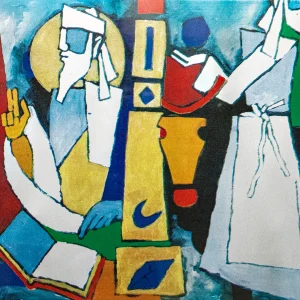
Dhiraj Chowdhury
Dhiraj Chowdhury (born September 1936) was a prominent Indian contemporary painter who famously rejected “art for art’s sake,” choosing instead to use his brush as a powerful weapon against social injustice.
Early Life and Career
Born in Bengal (present-day Bangladesh), Chowdhury’s life and artistic vision were permanently shaped by the horrors of the Partition and the Bengal Famine. He studied at the Government College of Art and Craft in Kolkata before moving to the capital, where he served as an influential educator at the College of Art, New Delhi, from 1961 to 1996.
Artistic Style and Legacy
Chowdhury labeled himself an “aggressive painter,” using dynamic, brisk lines and rich contours to challenge structural oppression. His style is defined by three key elements:
- Socio-Political Critique: His early works aggressively exposed corruption, the dowry system, and the misery of marginalized communities—such as famine-stricken peasants and the urban poor.
- The Transition to Love: In the late 1990s, his theme shifted radically. He began focusing on universal love, parenting, and companionship as healing forces to eradicate greed and violence.
- Feminine Resilience: His later portfolios celebrate empowered female figures, particularly the Devi (such as Durga), reimagined as symbols of raw strength and social transformation.
Legacy and Later Years
Chowdhury was the only Indian artist invited to exhibit alongside Masters Salvador Dalí and Joan Miró at the late-1960s Swiss Biennale. He passed away on June 1, 2018, in Kolkata, leaving behind an impactful legacy of art used strictly as a tool for empathy and social awakening.